
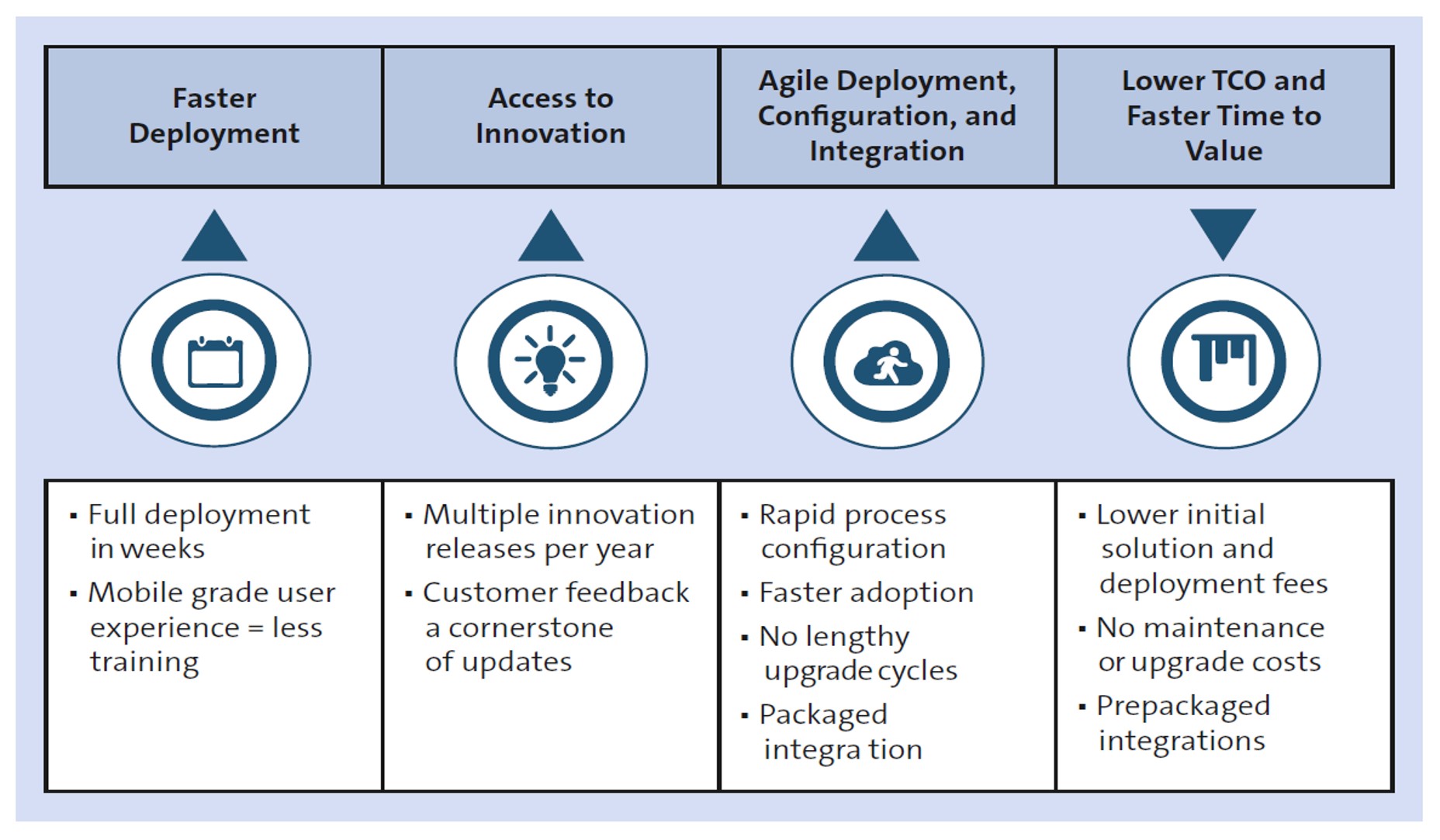
In the late 2000s and early 2010s, the concept of “cloud computing” led to a paradigm shift in how software businesses provided their solutions to customers. Because cloud applications could be wirelessly delivered, enhancements could be pushed to customers on a quicker schedule. Rather than rolling out one major release of a software application on a yearly basis (making exceptions for important patches for bugs and security issues), companies could now send innovations and release updates more frequently, resulting in greater value to the customer.
SAP transitioned its ERP software strategy in the early 2010s with the advent of the SAP HANA database and SAP S/4HANA, and began a march towards the cloud with the acquisitions of other solutions in the first half of the 2010s. Since the release of the SAP HANA Cloud Platform, SAP has encouraged customers to move from their on-premise landscapes to the cloud to take advantage of a handful of improvements.
Advantages of Cloud Solutions
There are numerous reasons why a company may want to take advantage of a cloud solution. For starters, some companies don’t have the IT support infrastructure to handle the technical backend of a system, and leasing a cloud solution relieves them of system maintenance. Similarly, administration responsibilities, such as security, can be reduced for a cloud customer as the provider handles security. This can translate into scalability without incurring large investment costs, and allows companies to focus on core business rather than managing the system backend.
Companies can save even more time and money by utilizing software-as-a-service solutions as they lower the time to value with a different implementation timeframe than on-premise versions. And as new functionality is added to the software and deficiencies or bugs are corrected, customers of cloud solutions can easily receive these improvements via the internet rather than a physical drive.
SAP S/4HANA Cloud
SAP S/4HANA’s introduction in 2015 was a key point in SAP’s pivot to a cloud-first strategy. As time passed, SAP regularly added functionality to the cloud platform with quarterly updates and detailed SAP Community documentation on new features. Customers of SAP S/4HANA Cloud can currently take advantage of the finance, supply chain and supplier relationship management, sales, and R&D lines of business, with additional functionality such as an HR line of business being planned for delivery in 2022.
SAP S/4HANA Cloud customers get all the benefits of the cloud solutions, as well as the business advantages of SAP HANA’s in-memory computing architecture. This gives them the ability to gain real-time business statistics and analytics.
SAP S/4HANA Cloud also includes embedded versions of other SAP solutions, such as SAP Enable Now, SAP CoPilot, SAP Analytics Cloud, and a test automation tool.
To learn more about SAP S/4HANA Cloud and the benefits it will bring to your company, contact us.