
Global megathemes are affecting the banking industry and are providing new opportunities for growth, while the banking industry is being reshaped by five major trends.
The quest for financial inclusion requires banks to take a leadership role in bringing financial services to underserved customers, creating opportunities for individuals, businesses, and economies. Financial inclusion is a key enabler to reducing poverty and boosting prosperity, resulting in:
- Greater social and economic well-being for individuals.
- Higher profits, increased competitiveness, and growth for businesses.
- Greater economic growth and decreased inequality (income and gender) across economies.
Increased customer expectations
Bank customers want and expect more from their banks. Today banks are trying to understand how to offer customized offers, products, and services beyond banking transactions while delivering the best customer experience.
Data as the new currency
Today, data analysis at banks is fragmented and piecemeal, making a deep understanding of customer needs and experiences very challenging. Banks are spending significant resources to reduce duplicate data and create a single view of each customer, from user history to user behavior, experience, and intent.
Platformification of banking
A new type of plug-and-play business model is appearing at banks that allows multiple participants (producers and consumers) to connect to the bank, interact with each other, and create and exchange value.
Evolution of banks into technology companies
Banks are reviewing and changing their organizational structure, technologies, and cultures to run more like technology companies than banks. To compete with the established technology firms for talent, they also need to understand and deliver the best employee experience.
Sustainability
Regulatory and public scrutiny of environmental, social, and governance (ESG) scores will continue to grow, and banks will need to measure and articulate ESG performance. Banks will have to standardize and tailor data for reporting requirements.
Digital strategies are disruptive and changing the rules for banks
Discovery Bank is using the latest technology and innovative process designed to provide the first behaviorally oriented global bank. By linking interest rates directly to users’ financial behavior, Discovery Bank is enabling clients to earn more interest on savings and pay less interest on credit as users improve their financial behavior. Discovery Bank provides clients with an attractive ecosystem of rewards in the form of dynamic discounts that further deepen user incentives.
Compartamos is a bank that offers microfinance services such as loans, deposits, insurance, and payment services in Mexico. Using SAP® technology, Compartamos is able to do real-time profitability and loss analytics on its microfinance offers for mobile account origination, leading to better decisions on financial products and customer offers.
Paving the way for Business Model Innovation
By 2025 the role and revenue streams of banks will fundamentally change. A significant portion of bank revenue will come from nonbanking services, while banks will act as platforms for digital services.
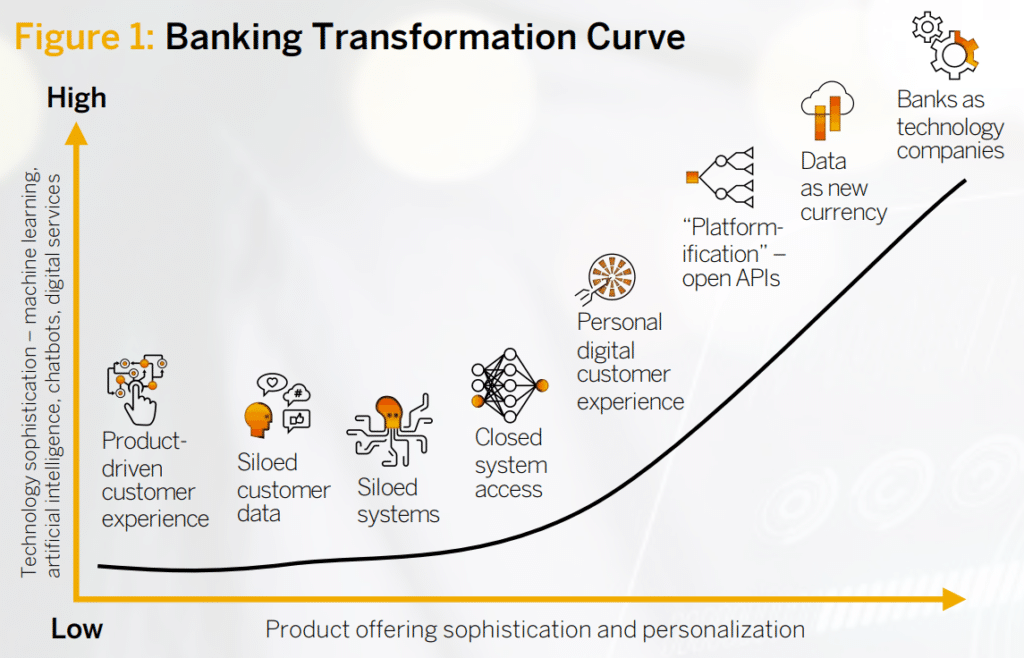
These services will reflect a wide range of banking and related nonbanking services to deliver an end-to-end (E2E) service orchestrated by the bank. Digitalized solutions will address the customer of one anytime and anywhere. These services will span from simple after-sales services to more-complex outcome-as-a-service models and the monetization of data assets that banks are able to generate based on the business they conduct.
Experience management will emerge as a primary driver and differentiator for the bank. To achieve this vision, banks must integrate and increase transparency of their own E2E processes and operations. Banks, now and in the future, need a real-world understanding of their customers’ experiences. They also need an environment in which they can learn from this information, make decisions, solve problems, and carefully manage the customer experience.